
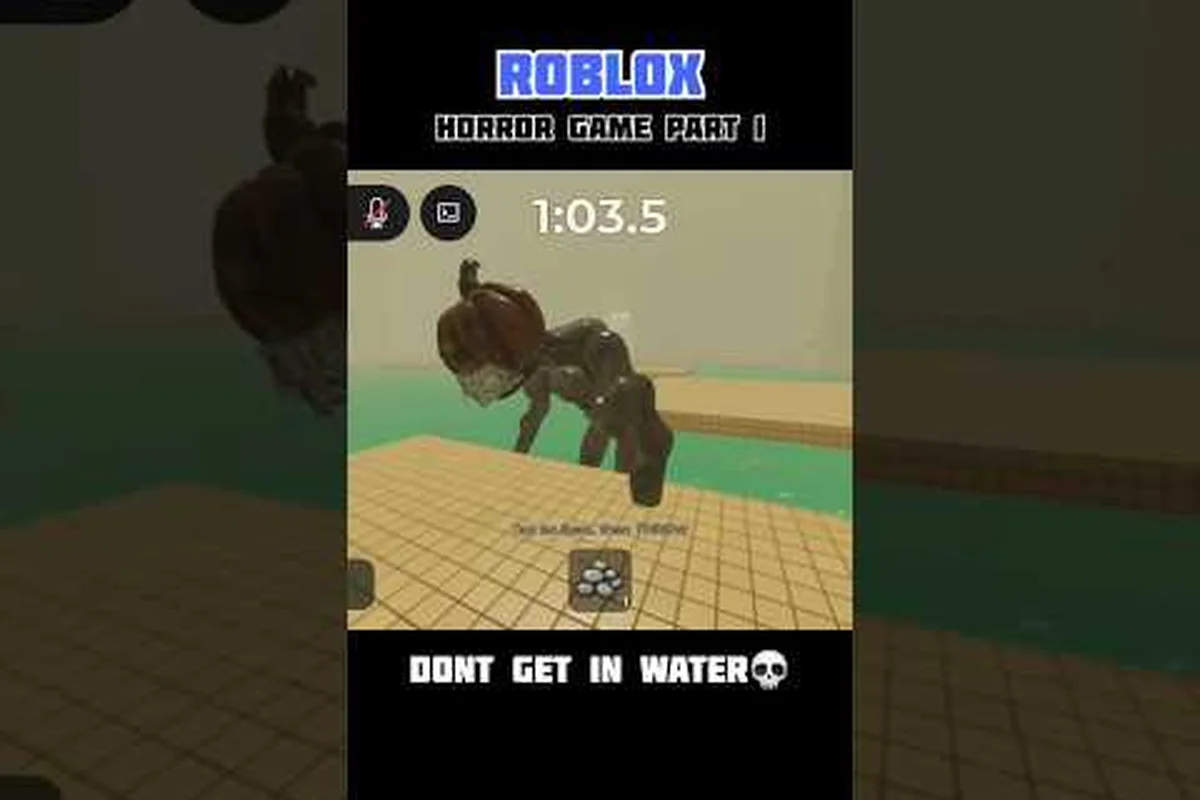
DONT SPLASH lore hides its story in flooded corridors, echoing tilework, and the certainty that IT is already watching. The warning matters because every splash can reveal a player’s position, while the game’s sparse details turn a simple survival challenge into a mystery about the entity, the complex, and the world beyond it.
The DONT SPLASH Story: A Facility Built for a Blind Watcher
The DONT SPLASH story begins without a conventional hero or spoken history. Instead, the game places players inside an endless-looking flooded complex where blue-gray tiles, warm pools of light, empty rooms, and reflective water establish a setting that feels half public facility and half dream. According to the official DONT SPLASH game page, the experience borrows its unsettling mood from the flooded, liminal look associated with the Poolrooms and from the haunted-building tensions of House of the Locust, so its visual identity is intentionally linked to familiar liminal spaces rather than presented as a unique cinematic universe.
That design choice makes the dont splash backstory elusive. There are no traditional ruins, guards, scientists, or explanatory notes to reconstruct an established incident. The setting appears functional, yet its purpose is never stated. Identical hallways continue into darkness, pools interrupt routes, and the entity called IT has no ordinary body. Because the environment supplies evidence without context, players must infer that something went wrong, that the water is more than decoration, and that the complex may be watching.
| Story element | What the player sees | Likely implication |
|---|---|---|
| Flooded tile corridors | Water covering parts of the floor | The complex is unsafe or deliberately submerged |
| Repeated empty rooms | Little variation between areas | IT may move unseen through familiar spaces |
| Warm ceiling lights | Sparse islands of visibility | Safety is temporary and local |
| Empty spaces beyond the light | Large areas without useful detail | The darkness conceals routes and entities |
| “IT KNOWS” warning | A direct threat with no visible monster | The antagonist senses players rather than merely hunting them |
The warning acts as the story’s central thesis. IT does not need to see a player if it can hear them, infer their position, or already understand the maze. That possibility explains why sound and water are inseparable from the lore. A footstep may be safe, but a splash creates a louder, more distinctive signal. The danger is not only an attack; it is the loss of anonymity in a place where the player cannot know which routes IT controls.
What the official description establishes
The official listing provides a firm foundation for interpretation: DONT SPLASH uses the Poolrooms and House of the Locust as atmospheric inspirations, and its central warning is “DONT SPLASH, IT KNOWS.” It does not claim that IT came from the Poolrooms, that the complex is literally the Backrooms, or that the monster is a transformed former resident. Those ideas remain theories rather than confirmed history.
This distinction is essential when examining the dont splash mystery. The strongest interpretation is that DONT SPLASH borrows the visual language of the Poolrooms to create its own liminal horror scenario. Warm light above cold water, empty architecture, and indefinite repetition produce unease without requiring a detailed history. The more elaborate backstory exists mainly in the minds of players who want to explain why the setting feels so deeply unnatural.
IT, Water, and the DONT SPLASH Backstory
IT is the story’s antagonist, but its defining feature is uncertainty. Gameplay videos and player descriptions consistently identify the threat simply as IT, while the official tagline presents it as an all-knowing presence. No reliable source gives it a species, former identity, or conventional origin, so the creature’s backstory is better understood through behavior than biography.
The water appears to be the primary threat and detection system. According to community observations, the environment punishes rushing because the more a player disturbs the flooded floor, the more obvious they become. That relationship makes IT less like a fast monster and more like a hunter adapted to a sound-rich maze. It can remain unseen while the player assumes that silence equals safety.
| IT-related clue | Likely function | Confidence level |
|---|---|---|
| IT is usually discussed without a personal name | Preserves the entity’s inhuman status | High |
| Splashing draws attention | Makes water an active sensor rather than scenery | High |
| IT is associated with dark or unseen areas | Encourages fear of incomplete information | Moderate |
| The complex repeats similar spaces | Supports the idea that IT knows its layout intimately | Moderate |
| The game offers no confirmed origin | Leaves the backstory deliberately unresolved | High |
The dont splash story therefore operates as an absence narrative: the player learns what IT can do before learning what IT is. This makes the game more than a conventional chase scenario. Each movement decision becomes a negotiation between knowledge and exposure, because the player must learn enough to escape while revealing as little as possible.
The dont splash poolrooms connection strengthens this reading. A repeating, flooded maze resembles a system designed to contain movement—or at least to make every traveler generate a record. If IT knows every corridor, it may not need pursuit; it may only need to wait for careless noise at an intersection. That theory also explains the game’s blend of horror and obstacle course design. Progress remains visible, but the route through it remains uncertain.
For a closer look at the contrasting design principles, the analysis of DONT SPLASH’s Poolrooms-inspired atmosphere separates environmental inspiration from claims about a direct narrative connection. The comparison is most useful when treated as a mechanic-to-lore reading: Poolrooms’ flooded, repetitive spaces resemble DONT SPLASH’s exposure system, but that similarity does not prove shared characters or lore. In DONT SPLASH, the water turns every step into a possible signal for IT, so the environmental parallel supports the absence narrative without converting visual resemblance into evidence of a direct story connection.
IT knows, but how?
Three interpretations fit the evidence without pretending that the game has confirmed a precise mechanic: water noise may function as an acoustic cue for IT, the complex’s layout may let it anticipate familiar Poolrooms routes, or “IT KNOWS” may imply supernatural awareness beyond the official warning. The distinction matters because silence could conceal movement without making the player safe—if IT already understands the Poolrooms, a careful route may still fail. Conversely, treating every splash as a guaranteed trigger would overstate what the game explicitly confirms and turn an ambiguous warning into a false rule.
-
Acoustic detection: IT hears splashes through the maze and follows the disturbance toward its source. This is the clearest reading because the official warning directly links water noise with awareness.
-
Spatial omniscience: IT understands the entire complex and anticipates common routes. Repetition gives it an advantage even when the player moves silently, because there are fewer meaningful paths than the corridors visually suggest.
-
Psychic or supernatural awareness: The phrase “IT KNOWS” may be literal rather than physical. IT could detect players regardless of sound, making caution necessary but not foolproof.
These possibilities do not need to be mutually exclusive. Even if IT is supernatural, the game still rewards the player for treating water as dangerous. If it merely tracks sound, flooding the complex with noise is a deliberate way to amplify its power. The uncertainty is the point: players cannot prove which rule applies, so every splash carries the risk of failure.
Poolrooms Inspiration and the Limits of Direct Connections
The official game page explicitly names the Poolrooms and House of the Locust as inspirations, providing solid evidence for the dont splash inspiration behind DONT SPLASH’s atmosphere. The resemblance is visible in more than a generic tiled-wall aesthetic. Warm overhead light contrasts with cold blue-gray surfaces, water occupies otherwise mundane rooms, and long passages lead toward spaces that feel strangely vacant.
| Visual feature | Poolrooms-style association | Purpose in DONT SPLASH |
|---|---|---|
| Blue-gray tiled surfaces | Artificial, clean, overly uniform architecture | Makes the complex feel constructed rather than natural |
| Warm overhead illumination | Comfortable light in an uncomfortable setting | Creates pockets of apparent safety |
| Shallow standing water | Familiar surreal Poolrooms imagery | Turns walking into a risk decision |
| Long empty corridors | Liminal space with little human context | Encourages uncertainty and isolation |
| Repeating geometry | Endless-maze perception | Limits the player’s sense of progress |
| Absence of occupants | A world emptied of ordinary life | Implies that something else now controls it |
The official listing establishes artistic influence, not a shared fictional universe. Nothing in the verified description proves that DONT SPLASH takes place in the same building as the Poolrooms or that the DONT SPLASH monster is a Poolrooms creature. It is more accurate to describe the game as Poolrooms-inspired liminal horror: a separate scenario built from the same visual mood.
This distinction helps organize the many fan interpretations surrounding the dont splash mystery. Some players connect the game to the Backrooms because endless tiled spaces and disconnected rooms resemble backrooms-style environments. Others imagine the flooded facility as an experimental site, a failed containment zone, or a punishment for making too much noise. Those ideas provide engaging speculation, but they should not be presented as official facts.
Community videos reinforce the visual reading rather than resolving it. In Zac Worthy’s DONT SPLASH walkthrough, the camera pauses on glowing lights, blue-gray hallways, still water, and long empty spaces. Another no-commentary gameplay video allows the repeated rooms and disturbed silence to dominate. Neither video supplies a confirmed creator biography, which is precisely why the game’s environment functions as its narrator.
Reading the setting as a character
A useful way to approach the dont splash backstory is to treat the complex as a system designed around a single rule: do not create a noticeable signal. Repetition is not merely a production shortcut. It makes every corridor familiar enough to become dangerous, while visual differences remain too subtle to guarantee that a player is retracing a known path.
That design also changes the meaning of a splash. In a normal horror game, water might be visual mood dressing or a navigational obstacle. Here, it is part of the antagonist’s sensing system. The player is not simply avoiding IT; the player is trying to avoid creating a data point that IT can use.
The DONT SPLASH Mystery: Why the Complex Feels Aware
The central mystery is not a hidden room or a single shocking revelation. It is whether the world merely resembles a predator’s habitat or actively responds like one. The official tagline, “IT KNOWS,” transforms an otherwise ordinary sound warning into a claim of awareness, and the game supports that claim with environmental behavior rather than a long explanation.
Several details strengthen the sense that the complex is aware. The same kinds of spaces repeat, suggesting that its layout is not random. The brightest areas are safe only in a narrow, physical sense, because they still offer little information about what waits outside the light. Water connects spaces, potentially carrying information across the maze. Most importantly, the player cannot see far enough to confirm whether IT is absent, hidden, or moving in another direction.
| Observation | Reasonable interpretation | Stronger claim to avoid |
|---|---|---|
| IT appears to react to noise | It tracks audible disturbances | It always shares perfect information |
| Corridors look nearly identical | The maze may be endless or cyclical | The level literally has infinite geometry |
| The lights reveal little | Darkness supports concealment | Every dark corridor hides IT |
| The complex is flooded | Water may amplify IT’s awareness | Every splash causes instant capture |
| The lore never identifies IT | The creature may be intentionally unknowable | A hidden origin has been officially confirmed |
This mystery is most effective when players separate observation from assumption. The observable facts are that IT exists, the game strongly associates splashing with danger, and the official material identifies the Poolrooms and House of the Locust as atmospheric references. The speculation begins when assigning a reason for the flood, a history to the complex, or a method of sensing.
The sound-focused reading deserves particular attention because it turns the environment into an active system. A deeper examination of DONT SPLASH’s sound design and hidden clues shows how silence, splashes, and environmental effects carry information beyond simple jump-scares. This matters for lore because each sensory cue can support a different account of IT’s nature without ever forcing a single canonical solution.
A deliberately incomplete origin
The lack of a confirmed creator, experiment, or historical event is not necessarily missing writing. The dont splash mystery may be designed around implied backstory: players encounter the result of something terrible, but the cause remains outside the frame. The empty complex behaves like evidence after an evacuation, yet the absence of bodies, records, or signs of struggle removes any easy explanation.
This produces a useful hierarchy of certainty: the Poolrooms and House of the Locust connections are official inspiration, while the flooded rooms, repeating tiles, warm lights, and narrow routes are observable features of the dont splash environment. Interpretations of IT as a guardian, former inhabitant, collective intelligence, or architecture-born creature remain theories rather than confirmed backstory, leaving the empty complex open for a personal story without making every claim about DONT SPLASH lore factual.
-
Official: DONT SPLASH draws atmosphere from the Poolrooms and House of the Locust, and IT knows when a player splashes.
-
Observed: Flooded rooms, repeating tiles, warm lights, dark corridors, and narrow routes shape the experience.
-
Community theory: The complex is a prison, experiment, afterlife, hidden base, or altered version of the Backrooms.
-
Speculative extension: IT may be a guardian, former inhabitant, collective intelligence, or creature born from the flooded architecture.
Keeping those levels separate produces a clearer dont splash story than presenting every theory as fact. It also explains why the lore continues to develop: each player can project a personal history onto the empty rooms while the fixed environmental details constrain what is plausible.
Reading DONT SPLASH Theories Without Losing the Story
The most satisfying theories connect IT, the water, and the architecture into one system, but they still need to explain the official warning rather than contradict it. A theory does not become stronger simply because it sounds ominous. It becomes more credible when it accounts for the repeated rooms, the flood, the visibility pattern, and the danger of noise.
Theory one: IT is a containment guardian
In this interpretation, the complex was designed to hold something dangerous. The flood both conceals evidence and creates an acoustic perimeter. IT patrols the maze, and careless players violate the system that keeps it contained. The “do not splash” instruction would then be a practical rule learned from earlier failures.
This theory fits the infrastructure, especially the lack of windows, signage, and natural geography. However, it also assigns a human institution and deliberate purpose that the official material does not confirm. It should remain a strong inference, not an established backstory.
Theory two: IT is a consequence of the space
Here, the complex is not a prison but the habitat itself. The repeating hallways and constant water form an ecology, and IT is its apex predator or a physical manifestation of the maze. The warning does not mean IT understands language; it means the entire system senses intrusion.
This model gives the dont splash poolrooms influence a more direct role. The architecture creates a surreal environment that behaves like one organism, while IT is the part players can perceive. It also makes the uniform tiles meaningful because sameness is evidence of intentional construction, even if no builder is ever shown.
Theory three: the player caused the flood
A darker possibility is that the player is not an innocent entrant but the source of the event. The complex may have been dry before the current state, and a failed experiment or destructive action flooded it. IT could be another victim, a failed artificial intelligence, or the remaining defense of the facility.
This theory creates a meaningful dont splash backstory because the mystery then concerns responsibility rather than mere survival. Unfortunately, the evidence remains circumstantial. Without an explicit memory, cutscene, or environmental record, claiming player culpability goes beyond what current verified material supports.
Comparing the strongest theories
| Theory | Explains warning | Explains water | Explains maze | Evidence status |
|---|---|---|---|---|
| Acoustic guardian | Strongly | Partly | Well | Community interpretation |
| Predator of flooded space | Well | Strongly | Well | Community interpretation |
| Manifestation of the complex | Well | Strongly | Strongly | Community interpretation |
| Failed containment facility | Well | Partly | Strongly | Speculative |
| Player caused the flood | Weakly | Partly | Partly | Highly speculative |
| Direct Poolrooms story connection | Weakly | Weakly | Moderately | Not officially established |
The best current synthesis is that DONT SPLASH tells a deliberately minimal story: an unknown intelligence occupies a flooded, repeating complex and detects conspicuous player activity. The origin of both the creature and the facility remains open, allowing the dont splash mystery to remain active without creating false certainty.
Those unresolved questions also shape player behavior, and the DONT SPLASH beginner guide explains how observation, route selection, and water avoidance affect survival. Lore is most useful when it changes how a player reads the environment rather than when it merely supplies decorative backstory.
What the DONT SPLASH Lore Establishes and Leaves Open
The dont splash lore currently establishes a small but meaningful set of facts. The game takes place in a flooded tiled complex. The official description names the Poolrooms and House of the Locust as inspirations. The antagonist is called IT, and the phrase “IT KNOWS” establishes awareness as the central threat. The environments emphasize empty rooms, long corridors, reflective water, and warm light surrounded by dimmer spaces.
What remains open includes IT’s physical form, the reason for the flood, the complex’s history, and whether every noise attracts the same response. The game’s minimalism may be permanent, or future updates may add context. Until any official source supplies more, the responsible approach is to identify confirmed details, describe community theories, and clearly mark speculation.
| Question | Best-supported answer | Remaining uncertainty |
|---|---|---|
| What is IT? | An unseen entity that detects or anticipates players | Whether it is biological, artificial, supernatural, or spatial |
| Why is there water? | It creates danger, sound, and visual continuity | Whether it is accidental, experimental, or intentional |
| Is it the Poolrooms? | The game is inspired by the Poolrooms atmosphere | No confirmed shared location or canon |
| What happened here? | Something made the complex hostile and empty | The responsible party and original purpose |
| Why “IT KNOWS”? | Noise and environmental cues can expose the player | The exact extent of IT’s awareness |
| Is the story complete? | No | Updates may add records, dialogue, rooms, or events |
The dont splash poolrooms comparison remains one of the most valuable interpretation tools because it explains the environment’s emotional effect. The repeating tiles create unreal familiarity, while pools of warm light suggest a mundane place that has stopped behaving normally. IT makes that discomfort personal by turning an environmental feature into a possible signal.
At the same time, the story gains depth from what it refuses to specify. A named scientist, dated disaster, or complete monster biography would answer questions but might weaken the sense that the player is trespassing inside an unexplained system. DONT SPLASH instead leaves the cause outside the frame and concentrates on the experience of being noticed.
Frequently Asked Questions
What is the main story in DONT SPLASH?
DONT SPLASH follows a player exploring a flooded, repeating complex while avoiding IT. The official material provides little explicit history, so the story comes mainly through environmental details: tiled rooms, shallow water, warm lights, and empty passages. The central tension is that noise reveals the player to a seemingly aware entity.
Is DONT SPLASH directly connected to the Poolrooms?
The official game page lists the Poolrooms as an inspiration, so the visual influence is confirmed. A shared fictional location is not. The relationship is best described as atmospheric: DONT SPLASH uses surreal tiles, water, and indefinite corridors to create a Poolrooms-like liminal horror setting within its own scenario.
What is IT in DONT SPLASH?
IT is the name of the game’s central entity and the force behind the warning not to splash. Its exact nature, origin, and detection range remain unexplained. Community theories describe IT as a guardian, supernatural presence, artificial intelligence, or inhabitant of the flooded space, but no official source confirms one identity.
Does the water reveal a player’s location?
The warning and observed gameplay strongly associate splashing with danger, although the precise detection rules are not publicly documented. Players should treat every noisy movement as a possible signal. Walking carefully, avoiding unnecessary water, and listening for environmental changes are safer than assuming IT cannot hear nearby disturbances.
Does DONT SPLASH reveal why the complex is flooded?
No confirmed public explanation establishes the flood’s cause. Community interpretations include a failed experiment, containment accident, deliberate acoustic defense, or a habitat created by the entity itself. Until an official update adds records or events, the water’s purpose remains central to the dont splash mystery rather than settled backstory.