
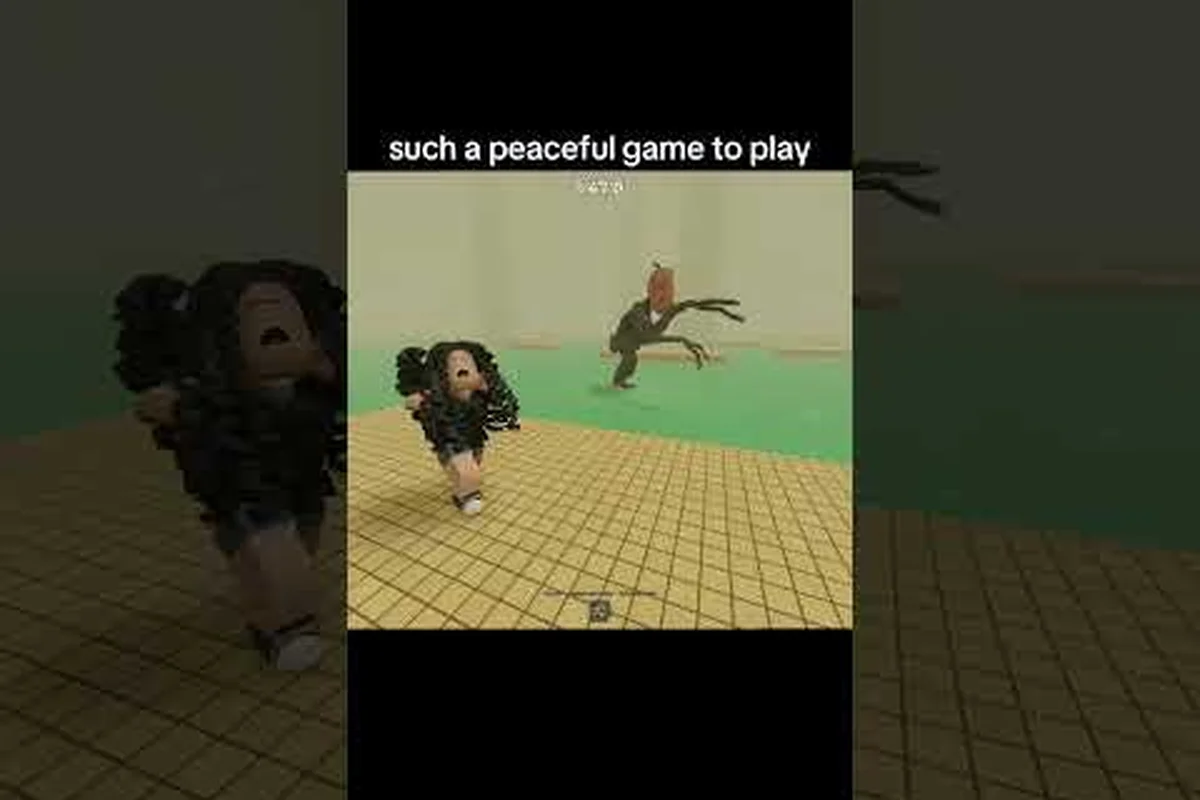
DONT SPLASH psychological horror works because it turns a simple sound—a splash—into evidence of an intelligent threat. The blind stalker, flooded corridors, and uneasy calm make every quiet room feel watched, even when nothing appears.
DONT SPLASH Psychological Horror and the Presence of IT
The central fear in DONT SPLASH is not that the creature can see you. It is that you can never be certain when it is nearby. The official DONT SPLASH game page on Roblox describes an experience inspired by the eerie atmosphere of Poolrooms and House of the Locust, establishing water and abandoned architecture as more than background decoration.
That premise produces the game’s strongest DONT SPLASH psychological horror effect: movement itself becomes meaningful. Running normally may be safe, but a sudden slip, jump, or fall sends a loud splash through the complex. The player hears danger before seeing it, while IT remains largely hidden.
| Horror Element | Immediate Fear | Psychological Effect |
|---|---|---|
| Blind stalker | It may already be close | Makes hiding feel temporary |
| Water sounds | A mistake exposes the player | Turns ordinary movement into a risk decision |
| Empty corridors | An approaching presence may be hidden | Reduces the feeling of safety |
| Warm, quiet lighting | The setting looks inviting | Creates contrast with the lethal threat |
| Unclear creature identity | The antagonist remains mysterious | Encourages player-made interpretations |
The design also follows the sound-based stalker concept described on developer slo7th’s official Roblox profile. Blindness does not make IT harmless; it shifts the danger from sight to sound. A person can stand still, but an anxious player may breathe loudly, move through shallow water, or make a mistake that reveals their position.
Sound-based pursuit is the key to the game’s identity. Unlike a monster that chases directly, IT turns the player’s own actions into possible information. This makes DONT SPLASH psychological horror intimate because the source of danger is not simply outside the scene—it is partly generated by the player.
DONT SPLASH Dread Atmosphere Through Still Water and Empty Space
The DONT SPLASH dread atmosphere comes from a deliberate contrast between comfort and danger. The complex features blue-gray tiled hallways, pools, warm overhead lights, and long passages that may look familiar enough to suggest an ordinary public facility. Yet the absence of people, signs, and clear destinations makes that familiarity feel artificial.
The official description’s comparison to Poolrooms-style spaces is useful, but DONT SPLASH adds a distinct sound threat rather than copying the visual concept directly. Empty rooms no longer feel like a puzzling environment; they become listening posts. Every corridor can conceal IT, and every reflective pool can produce an unwanted sound.
| Spatial Feature | What It Looks Like | Why It Creates Dread |
|---|---|---|
| Tiled corridors | Clean, repetitive, institutional | Repetition makes turns difficult to anticipate |
| Still pools | Flat, reflective, strangely calm | Water is both scenery and evidence of movement |
| Warm lights | Ordinary, welcoming illumination | Safety cues feel unreliable |
| Featureless walls | Few landmarks or signs | Players lose orientation quickly |
| Long sightlines | Open paths with distant corners | Empty space can conceal a silent approach |
This creates the liminal pool effect described by players: a place that resembles somewhere public but has lost its normal social purpose. There are no crowds to provide context, no employees to explain the layout, and no windows to connect the interior to the outside. The building exists as a maze because that is the only fact players can verify.
Community footage, such as the no-commentary stage walkthrough by Peta Perjalanan, highlights how sound and silence shape the experience. With no player commentary covering the environment, the repeated rooms, water surfaces, and empty passages carry the atmosphere on their own. The horror comes less from a jump scare than from the impression that the complex is waiting.
For more on the design lineage behind these spaces, the related discussion of DONT SPLASH’s Poolrooms-inspired atmosphere explains how familiar backrooms aesthetics become unsettling when they are stripped of context and populated with a predator.
DONT SPLASH Unsettling Dreamlike Atmosphere
DONT SPLASH dreamlike horror depends on uncertainty more than surprise. Players move through a sequence of similar rooms, encounter pools with no clear purpose, and try to solve a route while accounting for an enemy that may be listening. The setting feels like a half-remembered dream because its visual rules are simple, yet its physical consequences remain lethal.
That dream quality can be analyzed through three layers: the environment, the unseen stalker, and the player’s interpretation. Each layer reinforces the others, and the game rarely provides a complete explanation that would eliminate the mystery.
| Layer | Evidence in the Game | Meaning for Players |
|---|---|---|
| Environment | Repetitive tiled rooms and still pools | The complex feels constructed but purposeless |
| Stalker | IT is blind and drawn to water sounds | Hiding depends on controlling noise |
| Interpretation | No explicit explanation for the flood | Players imagine causes that deepen the unease |
| Movement | Progress requires jumps and crossings | Routine platforming becomes exposure |
| Sound | Splashes interrupt the otherwise quiet space | Calm is temporary and cannot be trusted |
The ambiguous flooded complex is especially important to the lore. There is no established reason the facility is covered in water, so the environment resists a clean explanation. It might resemble a neglected leisure center, an experimental complex, a failed sanctuary, or something older and more abstract. The game does not need to settle the question because the lack of an answer keeps every corridor open to reinterpretation.
This approach also gives the DONT SPLASH horror vibe considerable range. It can feel like a chase game during loud passages, a stealth scenario around IT, or a surreal exploration puzzle when the route ahead is unclear. The same pool changes meaning depending on whether a player sees it as scenery, a necessary crossing, or a possible hiding place.
The horror is dreamlike because the rules feel emotionally consistent even when they are not logically explained. Water means exposure, stillness means tension, and distant corridors become important precisely because no movement is visible. Players learn the emotional grammar of the place without receiving a complete manual for its history.
DONT SPLASH Halloween Dread and the Power of Quiet
DONT SPLASH halloween dread does not depend on pumpkins, monsters in costumes, or constant jump scares. Instead, the game borrows from a quieter Halloween tradition: the sense that an ordinary place has become dangerous after ordinary rules stopped applying. The warm lights, vacant halls, and pools of standing water make the complex feel like a festive attraction abandoned before opening.
| Traditional Halloween Fear | DONT SPLASH Equivalent | Emotional Effect |
|---|---|---|
| A haunted house | An endless flooded facility | Familiar architecture becomes unsafe |
| A costumed monster | A blind entity called IT | Recognition is less important than dread |
| A hidden trick-or-treater | An unseen listener | Every sound suggests a possible watcher |
| A dark basement | Dim corridors and deep water | Uncertainty replaces graphic horror |
| Sudden scare | Delayed pursuit and silence | Tension lasts longer |
The official game page identifies the Poolrooms and House of the Locust as inspirations, and both comparisons point toward atmosphere-first horror. However, the game’s calm presentation is not merely a setting choice. It gives the player time to hear footsteps, recognize recurring spaces, and react to changes in the environment.
A player who learns to identify the entity by sound and movement gains more than a tactical advantage. They also become sensitive to quiet as a warning sign. A room that once felt safe now contains several possible explanations: IT may be beyond the next turn, behind a door, or waiting in water. This uncertainty is the core of the DONT SPLASH dread atmosphere.
Community analysis also tends to treat the game’s quietness as a defining feature. Gameplay recordings such as Zac Worthy’s DONT SPLASH walkthrough show how the lighting and flooded tile corridors can remain visually calm without losing their oppressive quality. The absence of constant visual action leaves enough space for the player to imagine what has not yet appeared.
DONT SPLASH Psychological Horror Through Sound, Sight, and Choice
The game’s horror becomes understandable when its threats are separated into sensory categories. IT cannot rely on sight in the same way a normal predator would, so sound becomes the primary danger. The player, however, can still use sight to identify landmarks, route options, water depth, and likely hiding places. That asymmetry creates a useful decision loop.
| Threat Signal | What It Tells the Player | Best Immediate Consideration |
|---|---|---|
| Distant splash | IT or another water contact may be active | Stop and listen before continuing |
| Sudden splash behind the player | A mistake may have revealed the position | Change direction without creating extra noise |
| Repeated room pattern | The player may be looping or confused | Compare tiles, lights, and turns |
| Visible pool | Crossing may create noise | Check for alternate routes and safe landings |
| Sudden silence | Not proof of safety | The environment may be hiding an approach |
The practical goal is not to move as silently as possible in every situation. It is to avoid creating a distinctive sound pattern that IT can associate with the player’s location. A steady pace through dry or shallow areas may be safer than panicked jumping, while a carefully planned water crossing may be better than a fast but noisy route.
Reading IT Without Seeing IT
The blind stalker changes how players interpret visual information. A corridor that appears empty may still be dangerous, but IT also cannot simply pursue a motionless target with perfect accuracy. This creates a contest of imperfect information. The player gains a chance by pausing, while IT gains information when water, falls, or hurried movement breaks the silence.
Community lore discussions often focus on whether IT is a singular entity, a supernatural presence, or a creature native to the flooded space. The safest interpretation is that the game treats IT as more than a conventional monster. The name itself, as visible in community footage such as UnoTwo’s gameplay recording, reinforces a force defined by function rather than biography.
Why Stillness Can Be Strategic
Standing still is often portrayed as a horror cliché, but DONT SPLASH makes it more than a reflex. Because the threat is blind, deliberate silence can matter. The danger is not that remaining still causes instant death; it is that waiting also means giving IT more opportunities to approach.
A useful mental routine is to divide each room into sound zones. Mark water, tile edges, distant turns, and likely pursuit lanes. Then choose movement based on the room’s acoustic risk rather than only the shortest path. A slightly longer dry route may be preferable when the direct route crosses a wide pool.
Treat Each Environmental Detail as Information
Repeated architecture allows experienced players to build a mental map, yet repetition also creates false confidence. Two corridors may look nearly identical, and lighting may obscure small differences. Signs of water disturbance, room layout, and the direction of previous turns are therefore more valuable than decoration alone.
The complex can be understood as a psychological maze: it does not only determine where the player walks but also what the player expects. If a room appears familiar, the player may relax before checking the surface. IT benefits from that moment of recognition, which is why the DONT SPLASH horror vibe ultimately depends on the player’s own tendency to underestimate repetition.
DONT SPLASH Lore Interpretations and the Limits of Certainty
The sparse premise of DONT SPLASH allows several interpretations without requiring players to choose one canonical answer. Because the game uses a blind entity, a flooded facility, and the warning not to splash, its lore can be read as environmental, supernatural, or psychological. These readings can coexist without changing the underlying experience.
| Interpretation | Evidence Supporting It | Effect on the Story |
|---|---|---|
| Supernatural entity | IT seems drawn to sound and may inhabit the complex | The facility may be a trap or feeding ground |
| Experimental facility | Repetition and institutional tiles suggest a controlled site | The flood may be a failed test or containment breach |
| Abandoned leisure space | Pools and corridors resemble a public facility | The danger may have transformed an ordinary place |
| Mental distortion | Similar rooms and unclear navigation mimic a dream | The complex may reflect the player’s perception |
| Unknown origin | The game supplies no firm explanation | Each player can project a distinct history onto it |
These readings are interpretations rather than confirmed facts. The official material establishes the inspirations and the basic identity of IT, while detailed explanations remain open. For readers interested in the game’s wider cultural momentum, the article on why DONT SPLASH is trending among Roblox horror fans provides useful context for its community reach.
The strongest interpretation may be that uncertainty is intentional. A complete answer could explain the flooded rooms, but it would not necessarily improve the fear. Knowing why water is present does not tell the player where IT is, and a rational explanation for the creature would still not remove the possibility of being heard.
Implication over exposition is therefore the game’s defining lore technique. The environment offers fragments, but it never arranges them into a complete testimony. Players encounter contradictory impressions: the building feels abandoned, yet IT appears to inhabit it; the pools look like obstacles, yet they also seem to grant IT information; the corridors feel endless, yet each stage eventually provides a route forward.
That final point matters. Although the game’s identity leans toward psychological horror, it remains structured as an obstacle course with stages. The related DONT SPLASH obby guide can help readers interpret movement challenges, but the lore around those obstacles is deliberately incomplete. Progress proves that the complex permits an exit even when the reasons for its design remain obscure.
DONT SPLASH Psychological Horror: The Final Interpretation
DONT SPLASH psychological horror is built from a precise imbalance: the player can often see the route, but IT can often hear the mistake. That contrast turns simple actions such as running, jumping, and falling into tense decisions. The flooded architecture does more than decorate the game; it gives every noise a consequence and every quiet room a possible witness.
The most effective interpretation of the game is not that IT is simply chasing the player. IT is acting as the audible proof that the complex is inhabited, while the pools and repetitive corridors sustain the illusion of a place that only resembles reality. Whether that place is a failed experiment, a supernatural hunting ground, or a dreamlike trap remains unresolved by design.
The lasting takeaway is simple: every splash is a potential confession. Moving carefully, recognizing repeated spaces, and treating silence as uncertain can improve survival, but the deeper achievement is learning to inhabit the game’s atmosphere. That is where DONT SPLASH dreamlike horror, liminal pools, and sound-based pursuit become one unified horror experience.
Frequently Asked Questions
What makes DONT SPLASH psychological horror effective?
Its effectiveness comes from combining a visible route with an invisible threat. IT is blind, but water can reveal a player’s position, while empty corridors conceal the creature. The contrast makes ordinary movement feel dangerous even when players cannot identify an immediate enemy, because every splash may mark them as a target.
Is the monster in DONT SPLASH blind?
Community and official descriptions identify IT as a blind entity that relies on sound rather than normal sight. That detail does not make the creature harmless, since hurried steps, falls, and water crossings can still produce audible clues. Its limited vision also creates opportunities for careful players who can remain quiet and control their route.
Why are the pools in DONT SPLASH unsettling?
The pools combine familiar recreational imagery with an unexplained setting. Their reflective surfaces can look calm and decorative, yet crossing them can create the splash that reveals a player’s location. That contrast contributes to the DONT SPLASH liminal pools idea: ordinary architectural elements become threatening because the environment has no reliable social or practical purpose.
Does DONT SPLASH use jump scares or quiet horror?
The game emphasizes sustained dread rather than relying only on jump scares. Long corridors, repeated rooms, quiet footsteps, and sudden water sounds allow tension to build between encounters with IT. Community footage consistently highlights this calm presentation, suggesting that the horror vibe comes from anticipation and uncertainty as much as from a creature appearing.
Is the story of DONT SPLASH explained anywhere in the game?
The game leaves major questions unresolved, including why the complex is flooded and what IT truly is. The Poolrooms and House of the Locust influences provide an atmospheric framework, but they do not establish a complete canon for the setting. As a result, community interpretations remain part of the lore experience, though they should be treated as theories rather than confirmed facts.