
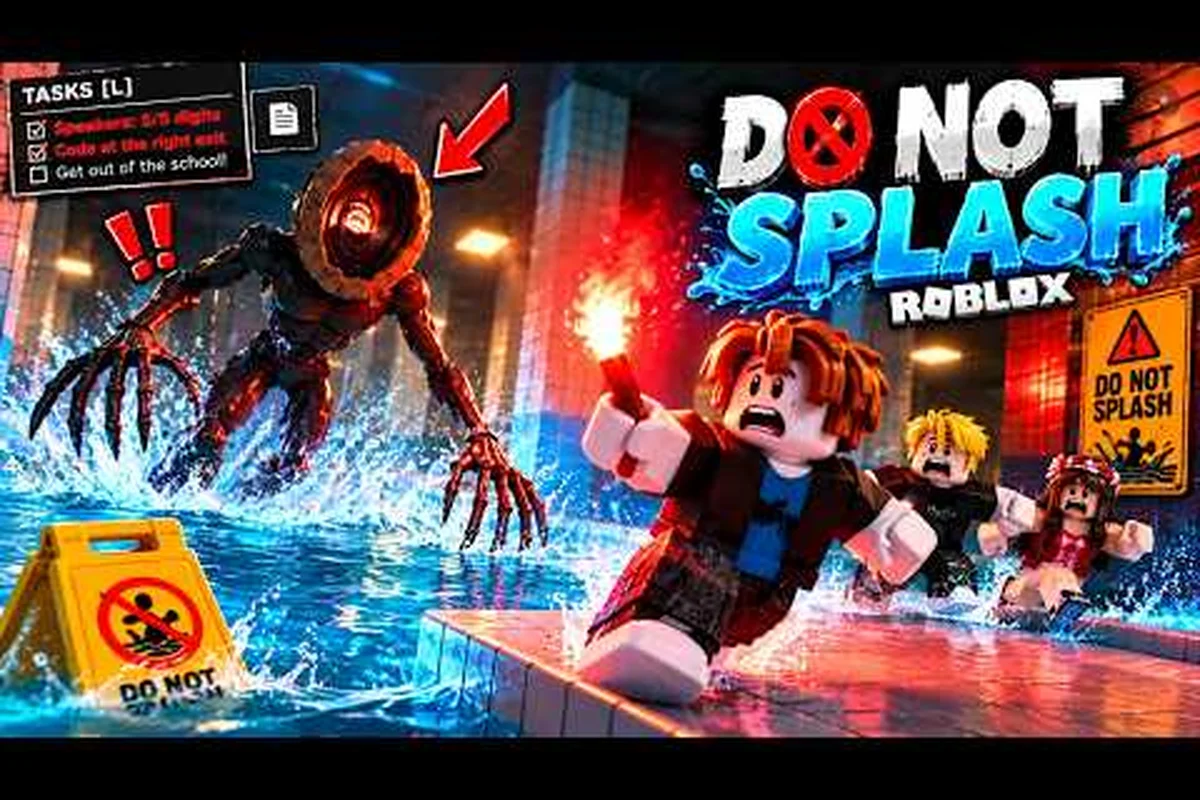
The dont splash horror obby theme explains why a flooded obstacle course feels genuinely threatening: warm lights over cold tiles, empty corridors, and the presence called IT turn every ordinary jump into a risk, so understanding the setting matters as much as mastering the jumps themselves.
The Core of the DONT SPLASH Horror Obby Theme
The dont splash horror obby theme centers on a flooded complex where every splash can summon a presence that appears to know exactly where you are. The official DONT SPLASH game page describes an atmosphere inspired by the eerie spaces of Poolrooms and House of the Locust, establishing a horror setting that feels more like a haunted memory than a conventional obstacle course. Get the full story behind the warning, the maze, and the entity called IT through this breakdown of the game’s visual language, implied lore, and most convincing symbolism.
The experience combines familiar obby movement with environmental danger. Players still need to jump, climb, and follow a route, but the threatening part is not simply failing a jump. It is making noise in a place where water reveals movement, splashes travel through empty corridors, and IT seems capable of sensing every disturbance. The result is a horror interpretation of the obby genre: progress remains clear, yet each successful obstacle brings the player deeper into the complex.
| Theme element | Surface meaning | Deeper implication |
|---|---|---|
| Flooded rooms | Obby obstacle course | A forgotten or artificial complex built around water |
| Repeated splashes | Failed jumps or ordinary noise | A signal that attracts IT |
| Empty corridors | Transitional paths | Liminal space with no reliable landmarks |
| The entity named IT | A pursuing monster | An unexplained intelligence that already knows the player is there |
| “DONT SPLASH” | Survival advice | A rule that may be imperfect, too late, or intentionally misleading |
The DONT SPLASH Horror Setting: A Flooded Complex Without a Past
The dont splash horror setting is designed around absence. The official listing emphasizes an eerie atmosphere influenced by Poolrooms and House of the Locust, and gameplay footage reinforces the impression through blue-gray tiled hallways, warm lights above still water, featureless walls, and long passages that appear to repeat without variation. The location is not presented as a normal public pool with obvious staff, signs, lockers, or recreational areas. Instead, it feels like a submerged complex whose original purpose is left unresolved.
That lack of context matters because a familiar location becomes frightening when familiar details disappear. A pool should contain daylight, doors, lane markings, voices, and maintenance equipment. Here, the same basic architecture feels isolated from ordinary life. Repetition prevents the player from building a reliable mental map, while the warm lamps reflected on the water make the blue spaces appear briefly inviting. The lighting therefore works as both attraction and warning: it guides the eye through the maze, but it also exposes every movement the player makes.
Architecture of the Abandoned Environment
The dont splash abandoned pool maze is more than a collection of jumps. It is a maze in the emotional sense, designed to make players question whether they are moving toward safety or simply following a route created for them. Repeated rooms, narrow approaches, flooded platforms, and empty halls remove the usual sense of progress. A player may complete one obstacle successfully and still feel as though the complex has rearranged itself around them.
Community walkthroughs consistently emphasize the same visual details: still water, glossy tiles, long corridors, and silence interrupted by splashes. A Zac Worthy walkthrough shows how warm overhead lights can make the setting feel dreamlike without removing its unease. Another no-commentary stage video lets the architecture carry more of the horror, since there is no active narration to explain what the corridors are meant to represent.
| Setting feature | What the player sees | Emotional effect | Narrative function |
|---|---|---|---|
| Blue-gray tiles | Cold, uniform surfaces | Clinical isolation | Removes signs of ordinary human activity |
| Warm lamps | Pools of inviting light | Temporary comfort | Draws attention toward the next route |
| Still water | Reflective, motionless planes | Held-breath tension | Makes every new ripple significant |
| Similar rooms | Repeating architecture | Disorientation | Prevents a stable mental map |
| Empty halls | No visible population | Exposure | Suggests the complex is built for a single presence |
| Long sightlines | Distant pools and doorways | Anticipation | Allows IT to appear at a distance |
Why the Complex Feels Artificial
The setting appears artificial not because the architecture is futuristic, but because it resembles a functional place that has been emptied of its function. Pool tiles, recessed rooms, corridors, and lamps suggest an organized facility, yet there are no ordinary signs of use. This makes the location feel like a stage prepared for a test rather than a home, resort, or municipal pool.
The most effective horror details are quiet ones. A splash can be loud, but the stillness before and after it is just as important. Silence tells players that no one else is moving through the space. The water reflects lamps and architecture, potentially hiding something approaching from a direction the player did not check. Empty rooms may therefore represent a choice rather than a lack of content: they provide enough visual information to tempt a wrong turn while withholding reassurance.
What the “IT KNOWS” Tagline Reveals
The dont splash tagline meaning is more unsettling when read as a statement of awareness rather than a promise of pursuit. The words do not simply say that a monster is nearby. They suggest that IT already has information, understands behavior, and does not need to search blindly. This distinction changes how every noise is perceived because the danger is no longer simply that a creature might hear something.
The phrase also creates a tense relationship between player and monster. The player can see only a limited area, while IT appears to possess a broader awareness. That asymmetry explains why hiding in a familiar room may not work as expected. Looking for a safe corner in the abandoned pool maze becomes less useful when the antagonist is framed as something that already knows the player’s presence. A more detailed examination of its behavior appears in the DONT SPLASH monster update analysis.
A Warning, a Threat, and a Possible Lie
“DONT SPLASH” sounds like direct advice, and “IT KNOWS” explains the reason. Taken at face value, the warning means that movement through water creates a signal IT can detect. Under that reading, a careful player should avoid unnecessary jumps, land on dry surfaces, and move only when needed. The entire complex then becomes a test of discipline because the obby’s basic action—splash—is also the thing that exposes the player.
Yet the warning does not specify who is speaking or how the information was obtained. It could be a helpful rule learned by earlier players, a warning left by a previous victim, or a statement made by the presence itself. A more unsettling possibility is that the advice is deliberately incomplete. IT may know the player has arrived even if they never make a sound. Silence could reduce danger without guaranteeing invisibility.
| Possible reading | Why it fits | What it changes for players |
|---|---|---|
| Sound attracts IT | Water amplifies movement inside empty halls | Avoid splashing and pause before risky jumps |
| IT has prescience | The tagline emphasizes knowledge, not merely hearing | Hiding alone may not remove the threat |
| The warning comes from a victim | Someone else may have discovered the rule | Environmental messages deserve careful attention |
| The warning is bait | IT may want the player to believe sound is the only issue | The entire route may contain a hidden second rule |
The Player as Source of Information
There is a deeper irony in the dont splash it knows meaning. The player observes the maze, reads signs, notices patterns, and learns by trial. IT is called IT, yet the player gradually becomes an interpreter of its behavior. In that sense, the tagline describes more than an enemy advantage: it establishes the player’s role as someone who can also learn its rules.
The horror obby format makes this investigation natural. Progress requires movement, while survival requires observation. A player cannot simply remain motionless forever because stages demand forward progress. The question becomes one of calibrated risk: which jumps are worth making, what sounds can be avoided, and which environmental details indicate that IT is close? The DONT SPLASH obby guide can help with practical movement, while the setting supplies the reason each careless action carries narrative weight.
Why Water Functions as the True Enemy
Water is the clearest symbol in the dont splash horror obby theme because it serves three roles at once. It creates the obstacle, reveals information, and communicates danger. Players may cross water because it lies between platforms, but every crossing risks changing the surface and announcing a precise position. The antagonist does not need to search the complex if the environment reports the player for it.
This design also makes sound central. The game’s identity is associated with splashes, but the deeper horror is silence: the moment before a jump, the space between footsteps, and the sudden interruption of a dripping room. Community footage describes quiet dread rather than constant aggression, suggesting that IT works best as a pressure that changes the atmosphere before it appears. The DONT SPLASH sound-design breakdown explores how audio turns a missed jump into a possible encounter.
Water as Revealer, Barrier, and Clock
A still pool can act as a mirror, exposing a silhouette or reflected movement. A disturbed pool can act as a barrier, making a route costly to cross. A rising body of water can act as a clock, reducing the number of safe actions remaining. These functions create tension even before IT physically enters the scene. The player must interpret the water’s condition and decide what it says about nearby danger.
| Water condition | Immediate gameplay implication | Possible lore reading |
|---|---|---|
| Perfectly still | Movement may be reflected clearly | IT could be nearby without revealing itself |
| Ripples from a jump | The player’s position becomes audible | The complex reports movement through sound |
| Dripping water | Background noise masks details | The environment may be designed to confuse perception |
| Rising water | Routes close and timing tightens | The facility may be reactivating or failing |
| Dry platforms | A temporary safe route | Safety may be local rather than permanent |
The central danger is therefore not simply contact with a monster. It is the loss of control over information. A splash reveals where the player stands, reflects movement, and forces a commitment. The abandoned pool maze is thus designed so that even successful movement creates evidence. That is why the setting feels coherent: every visual element supports the same underlying idea that observation itself can become dangerous.
How the Obby Format Creates the DONT SPLASH Horror Theme
Obbies and horror games ask different things of a player. A standard obby rewards precise timing, route knowledge, and repeated attempts. Horror rewards anticipation, uncertainty, and a willingness to interpret incomplete information. DONT SPLASH combines these systems rather than merely placing a monster beside familiar jumps. Failure in the obstacle course may be temporary, while failure to understand the environment can feel final or irreversible.
The contrast can be seen in its stage design. Players encounter obstacles that demand movement while the surrounding environment discourages it. The correct action may be to jump, yet the sound of doing so violates the apparent rule. This creates a productive tension: the level teaches movement, while the lore teaches restraint. Progress depends on contradiction, because the route is built to produce splashes even though the tagline warns against them.
Obby Rhythm as Horror Rhythm
Typical obby pacing uses short bursts of attention. A player runs, jumps, lands, and repeats. In the dont splash horror setting, those bursts become windows of exposure. The longer a player remains in one area, the more chances exist for a sound to reveal them. The longer they hesitate beside a pool, the more attention they direct toward every ripple and distant shape.
This structure also explains why a route guide can coexist with a lore interpretation. The pool maze layout analysis provides concrete information about routes and exits, while the lore explains why a technically safe path may still feel dangerous. A valve, door, or elevated exit represents more than progression when the surrounding complex is designed around pursuit. It can also represent a test of whether the player understands the warning.
| Obby convention | Horror reinterpretation | Effect on player behavior |
|---|---|---|
| Run between platforms | Exposure in long corridors | Rushing becomes less appealing |
| Land after every jump | A sound may mark your position | Landing locations require attention |
| Repeat a failed stage | IT can learn the same route | Knowledge of the level may not remove the threat |
| Follow visible signs | Signs may be incomplete or unreliable | Every instruction needs context |
| Reach the exit | Exit may represent being drawn deeper | Success raises new questions |
| Move quietly | Progress becomes slower and more deliberate | Patience replaces constant speed |
This is the heart of the dont splash horror obby theme. The obstacle course does not stop being an obby; its visible mechanics become the vocabulary through which the horror is expressed. Every familiar action acquires a shadow meaning, and every successful jump raises the question of what the sound has revealed.
Community Theories About the DONT SPLASH Abused Complex
The most compelling readings of the dont splash abandoned pool maze are interpretations rather than confirmed facts. The official page establishes the atmospheric inspirations, but it does not provide a complete history for the complex. Players and creators have therefore looked for patterns in the architecture, lighting, sound, and behavior of IT. Community reports should be treated as theories unless the game itself confirms them.
One theory proposes that the complex was once a controlled testing environment. Repetition, observation paths, and separated rooms could support that interpretation, but there is no visible laboratory equipment to confirm it. Another theory treats the setting as a digital or dreamlike reconstruction of a pool, where repeated spaces do not obey ordinary architecture. The liminal qualities of the corridors make this reading plausible as atmosphere, though it remains interpretation rather than established lore.
| Community reading | Supporting evidence | Limitation |
|---|---|---|
| The complex is an abandoned test facility | Controlled routes and repetitive rooms | No confirmed laboratory history |
| IT is a failed artificial guardian | Omniscient language and facility design | Creature origin is not explicitly explained |
| The pool is a dream or simulation | Surreal repetition and dreamlike lighting | The game offers no confirmed reality framework |
| IT was once a trapped victim | The warning may come from a previous escapee | No direct survivor narrative is provided |
| The warning is deliberately incomplete | IT “knows” rather than merely hears | This remains a theory based on wording |
| Water is reactivating the complex | Splashes, rising levels, and environmental response | The exact purpose of the water is uncertain |
A UnoTwo gameplay video captures the points players tend to discuss: IT lacks a detailed identity, water functions as more than scenery, and the complex never explains why it is flooded. That absence of exposition is important. The game’s lore is less like a traditional manuscript and more like an evidence board, with every sound, repeated room, and warning offering a possible connection.
The abandoned setting also makes the concept of “knowing” ambiguous. A machine system can know through sensors, a supernatural entity can know through perception, and a space can know because it is alive. IT’s lower-case name keeps all three possibilities open. It is less a conventional monster title than a label for an unknowable force, which makes the warning more flexible and unsettling.
Reading IT as Presence, System, or Predator
The dont splash it knows explained in narrative terms, IT is best understood as a presence operating inside the complex rather than a creature with a conventional origin. The name prevents a fixed classification. It could be a predator, a supernatural inhabitant, an abandoned security system, or something that combines those categories. What matters for the setting is its demonstrated capability: awareness reaches the player before any clear physical contact.
Treating IT as a system produces one interpretation. If the complex monitors movement, then water becomes a tracking medium and rooms are sensors. The player might infer that avoiding splashes works only until another kind of noise or movement triggers the same system. This theory fits the clean, repetitive architecture, but it does not explain every emotional detail, such as the sense that IT is waiting rather than processing.
Treating IT as a supernatural presence produces another. The complex may be a threshold between ordinary and unnatural spaces, and the repeated warning is less about technology than about knowledge passed between victims. Under this reading, quiet is not invisibility but restraint. A creature that “knows” can wait for a mistake without needing speed, which explains why quiet dread may be more important to the theme than a chase.
| Interpretation | What IT represents | Why the setting supports it | Best clue |
|---|---|---|---|
| Predator | An intelligent hunter | It can track the player through sound | Water reacts to the player’s movement |
| Security system | An automated protocol | The complex has a controlled, repetitive layout | Warning sounds like learned protocol |
| Supernatural presence | A force beyond normal cause | IT knows without a visible scouting process | Omniscient wording and dreamlike space |
| Former victim | Another trapped consciousness | The warning may be a message from the past | Advice comes with no identifiable source |
| The complex itself | A self-aware environment | Every room shares the same eerie identity | Repetition and the lack of an outside world |
None of these readings must be treated as an official answer. Their value is in showing how the game’s sparse details support several coherent interpretations. The setting remains horrifying because it never requires the player to select one explanation before continuing.
What the DONT SPLASH Tagline Means for Survival
The dont splash tagline meaning ultimately changes how players should read every instruction. “DONT SPLASH” sounds simple, but “IT KNOWS” makes it an incomplete survival rule. Avoid noise, and you may reduce one source of exposure. Do not splash, and you may still be observed. The sensible response is not to disregard the warning but to understand it as the first layer of a larger system.
Practical interpretation can be divided into three levels. The first is direct: a jump into water creates a splash, so landing choices matter. The second is strategic: players should observe whether a route triggers environmental responses, such as rising water or the appearance of IT. The third is psychological: even when no immediate danger appears, the player should remember that IT appears to understand the route and may already know which obstacle comes next.
| Interpretation level | Player response | Reason |
|---|---|---|
| Immediate sound avoidance | Choose controlled landings and reduce unnecessary movement | Splashes can disclose position |
| Environmental awareness | Watch water, lighting, doors, and repeated spaces for changes | The complex may signal IT’s proximity |
| Long-term caution | Do not assume one successful run makes the maze safe | IT’s awareness exceeds ordinary sight |
| Route awareness | Learn where exposure is unavoidable | Avoiding every sound is not always possible |
| Psychological resistance | Accept that visibility may be unavoidable | “Knows” is stronger than “hears” |
This layered reading preserves the game’s tension. A player who follows the warning mechanically may become afraid of every pool, while a player who ignores it misses an essential clue. The better approach treats the slogan as both evidence and warning: it tells them that the complex is responsive, but it does not reveal the full rules of that response.
The Lasting Meaning of the DONT SPLASH Horror Theme
The dont splash horror obby theme succeeds because every major element supports the same central idea: movement creates danger in a place that appears capable of awareness. The complex is not merely flooded; it is a maze built to expose, reflect, and remember. The obby is not merely difficult; it forces the player to make sound while warning them that sound is dangerous. IT is not merely a monster; it is an intelligence defined by what it knows.
That combination gives DONT SPLASH a distinct identity within Roblox horror experiences. Poolrooms-style imagery supplies the strange calm, while the obby structure adds momentum and clear goals. Quiet audio and empty corridors make the player sensitive to small changes. The tagline turns those sensory details into a simple instruction that remains difficult to follow. Ultimately, the game’s most effective message is not that players must be perfectly quiet, but that awareness itself has become dangerous.
Frequently Asked Questions
What does the dont splash horror obby theme focus on?
The dont splash horror obby theme focuses on movement becoming dangerous in a flooded complex where IT appears to know the player’s presence. Water reveals splashes, reflective pools expose silhouettes, and empty corridors create quiet suspense. The familiar action of jumping therefore doubles as a survival risk, combining obby progression with a horror story about observation, sound, and unwanted awareness.
What does “DONT SPLASH, IT KNOWS” actually mean?
The phrase most directly warns that splashing can reveal a player to IT, while “IT KNOWS” suggests a presence with awareness beyond ordinary sight. Its exact meaning remains unconfirmed, and theories range from a supernatural hunter to an intelligent security system. The safest interpretation is that avoiding noise may help, but silence alone does not guarantee safety because the tagline implies IT already understands the situation.
Is the DONT SPLASH setting an abandoned pool or a larger complex?
Available evidence describes the horror setting as a flooded, maze-like complex with tiled hallways, repeated rooms, pools, and industrial-looking passages. It resembles an abandoned pool, yet its scale and repetition suggest something more complex. The official game page also cites atmospheric inspirations, supporting the interpretation that the location is designed as a liminal, dreamlike space rather than a fully explained realistic facility.
Does the dont splash abandoned pool maze change between runs?
The available official information and footage do not establish whether every maze is randomized, and players should not treat procedural changes as confirmed. What is clear is that the setting repeatedly uses similar rooms, long corridors, and water-obscured routes. Whether those layouts are fixed, staged, or varied by update remains uncertain, so observations about changing paths are best described as player reports rather than a fixed mechanic.
Who or what is IT in DONT SPLASH?
IT is the entity associated with the warning and the game’s pursuit elements, but the game does not provide a clear origin, species, or biography. Community interpretations include a supernatural presence, a failed guardian, a security system, and a former victim. What the name communicates is function: IT knows, watches, or responds without needing a conventional explanation, which preserves the mystery surrounding the flooded complex.