
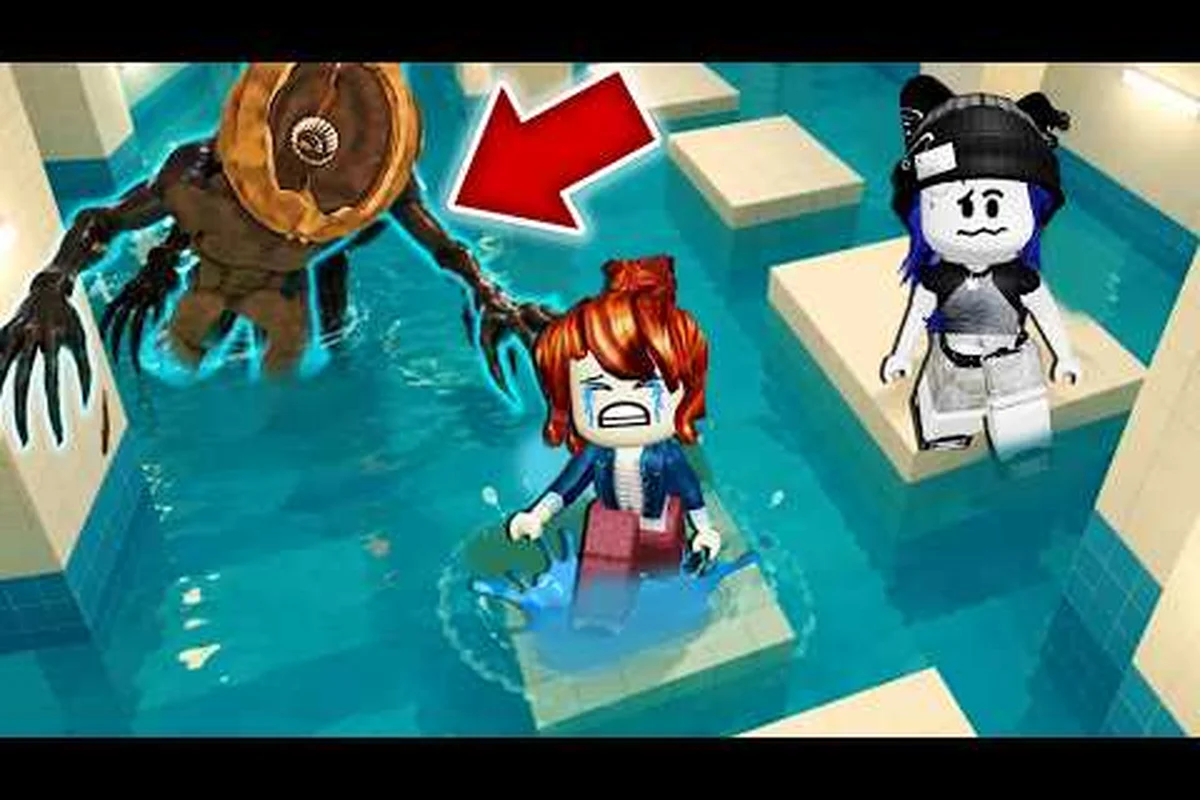
DONT SPLASH draws on poolrooms-inspired horror to turn empty architecture into a predator’s hunting ground. The result is a strange blend of backrooms-style repetition, liminal dread, and water horror, so recognizing those influences clarifies why its quiet spaces feel threatening.
Poolrooms Inspiration Behind DONT SPLASH
The official DONT SPLASH game page names two atmospheric references — the abandoned-pool look of the Poolrooms and the concealed-threat mood of House of the Locust. That wording is important because it connects the game to an established visual mood rather than claiming a literal crossover. The influence appears in tiled corridors, empty recreational spaces, shallow water, and the feeling that the environment has been abandoned without explanation.
A poolroom is normally communal, bright, and mundane. DONT SPLASH removes much of that social meaning. Its spaces are sterile, repetitive, and quiet, while the water changes from a harmless design feature into evidence of danger. The setting becomes a liminal space, meaning it feels suspended between familiar and unfamiliar places rather than belonging to a clear location.
| Visual element | Poolrooms association | DONT SPLASH use | Horror effect |
|---|---|---|---|
| Blue-gray tile | Public pool interiors | Repeating corridor walls | Makes spaces feel clinical and artificial |
| Shallow water | Pool floor and reflections | Hides movement and sound | Uncertainty replaces scenery |
| Empty pools | Abandoned recreation area | Silent navigation zones | Suggests sudden abandonment |
| Long hallways | Connected pool facilities | Endless-looking routes | Weakens orientation |
| Warm overhead lights | Poolside illumination | Pools of light in dark halls | Creates false safety |
| The creature | Unexpected swimmer | Presence within the complex | Turns observation into pursuit |
The dont splash poolrooms inspired concept works most effectively because the game preserves the poolroom’s recognizable architecture. Players can identify tile grids, shallow basins, and connected rooms, yet the lack of people, signs, and ordinary activity makes each space feel staged for something unknown.
More Than a Decorative Setting
The Poolrooms influence is not simply a skin applied to an obstacle course. Architecture controls movement, sight lines, and sound, which means each empty corridor changes how a player evaluates danger. A long hallway limits what can be seen ahead, while reflective water may conceal movement below the surface.
That is also why the dont splash liminal space quality matters. The complex feels physically coherent but narratively empty, like a location removed from ordinary time. Players encounter no clear history for the flood, and the creature known as IT has no visible explanation. The absence of context makes every room seem slightly displaced from a familiar reality.
A Quiet Kind of Wrongness
The dont splash eerie atmosphere depends heavily on restraint. Warm lights glow over blue-gray floors, and the environments may appear almost welcoming from a distance. The danger emerges when movement, sound, or an otherwise empty sight line proves inconsistent with that calm presentation.
This creates a specific contrast effect: ordinary pool architecture increases discomfort because it suggests safety, routine, and public activity. The horror does not need elaborate monsters or constant pursuit. It can arise from a splash arriving before the player makes one, followed by silence in a room that should be empty.
House of the Locust and Backrooms-Style Design
The game also draws from the haunted-house imagery associated with House of the Locust and from backrooms-style environments. These influences are complementary. House of the Locust suggests infestation, decay, and a hostile presence concealed inside an ordinary building, while the backrooms tradition emphasizes repetitive architecture, artificial lighting, and the loss of a clear route home.
The official page names both the Poolrooms and House of the Locust, confirming that the dont splash house of the locust connection is deliberate. However, the game appears to translate these references into its own visual language rather than recreating either setting exactly. Its clean tiles and still water remain recognizable, but the unsettling element is the creature’s proximity rather than visible swarms or overt infestation.
| Influence | Core association | What DONT SPLASH adapts | Distinctive result |
|---|---|---|---|
| Poolrooms | Abandoned aquatic interiors | Tiled rooms and shallow water | Water becomes threatening |
| House of the Locust | Infested haunted building | Hidden creature and eerie calm | Calm conceals predation |
| Backrooms style | Repeating impossible interiors | Long corridors and similar rooms | Navigation feels unstable |
| Liminal horror | Settings between ordinary places | Flooded, sparsely populated spaces | Familiarity feels wrong |
| Water horror | Threat beneath the surface | Splashes and concealed movement | Every pool becomes a question |
The Backrooms-Style Backrooms
The dont splash backrooms style appears in the repetition of spaces that appear interchangeable. Blue-gray surfaces, rectangular passages, pools of yellow light, and shallow water establish a visual rhythm. The player may recognize a turning point or landmark, yet each corridor still resembles the previous one.
That similarity prevents the complex from feeling geographically coherent. It also encourages players to rely on sensory details rather than a map. Water ripples, distant splashes, changes in lighting, and the creature’s movement may matter more than the route taken. The DONT SPLASH sound design overview explores how those cues intensify that loss of orientation.
House of the Locust Without Direct Imitation
House of the Locust contributes a different kind of suggestion: a familiar interior can conceal an organism that does not respect normal boundaries. In DONT SPLASH, the presence called IT is treated as something almost inseparable from the complex. Water, corridors, and silence seem to communicate information to it, while the player remains vulnerable within its environment.
The dont splash house of the locust influence therefore appears less like a direct model of a specific building and more like a mood of concealed infestation. There are no swarms required for that impression. A single distant splash, followed by an empty pool, creates a simpler and cleaner form of suspense.
Shared Traits and Clear Differences
| Trait | Poolrooms influence | House of the Locust influence | DONT SPLASH interpretation |
|---|---|---|---|
| Setting | Flooded recreation space | Haunted domestic or institutional space | Merged into an empty aquatic complex |
| Main threat | Often implied | Concealed invading presence | A water-sensitive creature called IT |
| Atmosphere | Sterile and dreamlike | Oppressive and eerie | Quiet, bright, and threatening |
| Player goal | Usually exploration | Survival and escape | Navigate while limiting splashes |
| Horror emphasis | Absence and wrongness | Infestation and intrusion | Environmental awareness |
The dont splash liminal horror is strongest when these influences are viewed as layers. Poolrooms supply the setting, the backrooms tradition supplies repetition, and House of the Locust supplies the sense of a concealed organism. No single element would feel as unsettling if the others were removed.
The Visual Grammar of DONT SPLASH
DONT SPLASH uses a small collection of environmental cues to create its tension. Their consistency matters more than their number. Blue-gray tile gives walls and floors a uniform surface, shallow water reflects light, and warm fixtures divide long corridors into repeated pools of visibility.
The aesthetic recalls footage players have compared to empty Poolrooms and backrooms content. In Zac Worthy’s DONT SPLASH walkthrough, the visual rhythm is especially clear: warm overhead light contrasts with cool tiled hallways, while still water and empty corridors dominate the frame. A separate no-commentary stages video similarly highlights the absence of aggressive music and the way silence allows each splash to register.
| Cue | Surface reading | Underlying implication |
|---|---|---|
| Uniform tiles | Clean, controlled facility | Artificial order with no visible purpose |
| Still water | Reflection or cooling | Concealed movement and approaching threat |
| Warm lighting | Visibility and safety | Illumination does not guarantee safety |
| Repeated rooms | Efficient layout | Potential for disorientation |
| Long sight lines | Time to react | IT may already occupy the distance |
| Empty pools | Abandoned recreation | A place where something may be waiting |
Color and Illumination
The warm-versus-cool color structure is especially effective. Warm lamps create pools of gold light, while the surrounding tiles remain blue-gray. This makes the complex feel hospitable only in fragments. A corridor can look safe at the near end while fading into cold, reflective space beyond.
The lighting does not eliminate darkness; it fragments it. That distinction matters because a fully black corridor offers fewer environmental details, whereas illuminated tile shows shape while hiding intention. Players can see enough to move, yet not enough to determine whether a distant shape is a fixture, a reflection, or IT.
Repetition With Deliberate Exceptions
A strong liminal space needs consistency, but total sameness becomes visually flat. DONT SPLASH introduces exceptions through water patterns, light changes, room layouts, and sound. The repeated architecture supplies the baseline, while those exceptions signal that the player’s route has changed.
That structure also gives creature encounters meaning. Because most features repeat, an unusual ripple or splash stands out immediately. The anomaly becomes the story, even when the game never provides a direct explanation for the flooded complex.
What the Architecture Leaves Unseen
DONT SPLASH relies on blind spots. Long hallways conceal distance, shallow water can distort reflections, and connected pools create overlapping sight lines. These limitations make observation unreliable, which is why the creature’s behavior is so important to the lore.
A detailed look at the creature and its possible sensing rules can clarify why ordinary visual contact may not mean the same thing as detection. For now, the important aesthetic point is that the player often sees evidence of activity without seeing its cause clearly.
Water as the Central Horror Element
Water is the element that connects the game’s influences. In a poolroom, water indicates recreation and order. In the dont splash water horror interpretation, it becomes a tracker, a warning, and a boundary. The official tagline frames IT as something that “knows,” and the available gameplay descriptions present water as an active danger rather than scenery.
The game’s title gives this threat an additional layer. A splash is both an action and evidence. Moving through flooded areas may produce noise, while IT may use that noise to find the player. The setting therefore transforms a basic movement requirement into a recurring decision: progress is valuable, but every step can carry a cost.
| Water condition | Likely visual meaning | Player decision | Horror function |
|---|---|---|---|
| Flat and reflective | No immediate disturbance | Cross quickly or wait | Creates visual uncertainty |
| Rippling outward | Something moved nearby | Retreat, freeze, or change route | Signals unseen activity |
| Rippling toward player | Possible approach | Escape immediately | Turns environment into warning |
| Deep-looking shadow | Unclear depth or object | Avoid the center | Preserves unknown below surface |
| Repeated splashes | IT may be nearby | Minimize movement and sound | Makes water the primary threat |
The Enemy Is the Environment
Most horror games separate the threat from the stage. DONT SPLASH blurs that line. The same pools that slow the player also reveal them, and the same corridors that offer escape also channel sound toward the creature. Its connection to the water gives the architecture a consistent purpose.
The official page’s “DON’T SPLASH, IT KNOWS” framing can be understood as a simple rule without requiring a full explanation of IT’s origin. The creature knows because the complex tells it. Splashes, echoes, and disturbed surfaces provide information in a place where those signals cannot easily be hidden.
Reading the Water
Players should treat surface movement as distinct from ordinary texture. Still pools offer more reliable reflections, while disturbed water can reveal direction. A ripple beginning away from the player may indicate IT’s path, though the environment could also produce ordinary movement. The ambiguity is intentional.
This makes careful observation more useful than staring at every pool. Identify the last known point of disturbance, compare it with the current position of IT, and avoid assuming that a distant shape is harmless. A broader explanation of water-sensitive monster behavior can help translate visual evidence into safer movement decisions.
Silence as Part of the Threat
The dont splash liminal space becomes more threatening when it is quiet because an empty pool should produce occasional drips, distant movement, or echoes. A sudden splash therefore breaks the established rhythm. Silence is not merely an absence of music; it is the condition that lets a single sound carry meaning.
This is why the sound design is inseparable from the lore. IT appears connected to noise, and the player learns the rules by noticing which sounds occur naturally and which arrive at the wrong moment. The environment teaches its own language even though it never provides a formal exposition screen.
Reading the Creature Called IT
Community footage and player discussions often refer to the antagonist simply as IT, and that lack of a personal name makes the creature feel less like a conventional character and more like a force occupying the complex. UnoTwo’s DONT SPLASH gameplay video captures the community’s tendency to theorize about its name, behavior, and relationship to the flooded environment.
| Reported element | Interpretation | Why it matters |
|---|---|---|
| The name IT | Deliberately impersonal | The creature may represent a system rather than a person |
| Water reveals movement | The environment tracks the player | Caution depends on surfaces |
| No visible origin story | Origins remain unexplained | Fear survives without exposition |
| Blind or sound-oriented behavior | Detection may not depend on sight | Visual distance is not always safety |
| It inhabits the complex | The monster and location are linked | Escape routes also become exposure risks |
An Antagonist Without a Biography
The creature’s undefined history is not necessarily a missing explanation. It supports the idea that the complex itself may be the source of the danger. Instead of learning where a monster came from, players learn how it moves, how it notices disturbance, and how the environment can betray them.
That approach also distinguishes DONT SPLASH from more explicit creature lore. The game communicates through repeatable behavior. A splash before the player enters a pool, a shadow crossing a distant corridor, or a route that becomes unsafe after noise can suggest an intelligence without defining its history.
IT as Part of the Poolrooms
Because the official description connects the creature to the poolroom atmosphere, IT can be read as the hidden presence that gives those empty spaces their purpose. Without it, the complex is merely surreal. With it present, every pool becomes a possible hiding place, every reflective surface a possible sensor, and every corridor a possible route it already knows.
The dont splash poolrooms inspired idea becomes sharper when the creature is understood as the final layer. The architecture creates unease, the lighting sustains ambiguity, and IT turns that unease into a gameplay relationship centered on sound, water, and attention.
A Practical Framework for Interpreting the Lore
The lore of DONT SPLASH is experiential rather than chronological. There is no reliable history for the complex, no reliable account of the creature’s origin, and no dependable explanation for the flood in the official material. The useful approach is to build a model from observable details and separate confirmed details from interpretation.
First, treat the visual setting as intentional. The official page establishes the Poolrooms and House of the Locust as inspirations, which makes tiled aquatic architecture a deliberate design choice rather than random decoration. Second, treat sounds as positional information. A splash has a source, a direction, and a consequence. Third, distinguish what the player sees from what IT appears to sense.
| Evidence level | Example | Safe conclusion | Avoid claiming |
|---|---|---|---|
| Officially stated | Poolrooms and House of the Locust are inspirations | The game uses those moods | A literal shared story or crossover |
| Directly visible | Tiled halls, shallow pools, repeated rooms | The environment uses aquatic liminal design | The location’s original purpose |
| Community-reported | IT is blind or reacts strongly to water | Detection may depend on sound | Exact hearing radius without testing |
| Interpretation | IT may be part of the complex | The creature and setting could be inseparable | A confirmed origin story |
| Speculation | The flood was caused by IT | A plausible reading of the imagery | Canon explanation |
Separate Observation From Theory
A careful reading of the dont splash house of the locust comparison should not claim that DONT SPLASH copies a specific house. The evidence supports a shared influence, especially in the mood of concealed danger. It does not establish shared characters, locations, or events.
The same caution applies to the backrooms comparison. Repeated halls and dreamlike architecture support that description, but the flooded setting and water-centered behavior give DONT SPLASH its own identity. Calling it “backrooms style” is useful shorthand for a visual tradition, not a complete lore statement.
Build a Cause-and-Effect Map
The most useful lore notes organize events by cause and effect. A player hears a splash, the splash changes IT’s behavior, and that behavior redirects movement through the complex. Another chain might involve moving water, seeing a reflection, and misreading the creature’s location. The DONT SPLASH lore theory overview can extend this method by comparing the community’s explanations for the creature’s origin and possible connection to backrooms-style spaces.
| Event | Likely player interpretation | Lore significance |
|---|---|---|
| Water moves before the player acts | IT may already be nearby | The complex provides advance warning |
| IT ignores a visible player | Vision may be limited | Its identity is tied to a different sense |
| Sound stops after a room is entered | The creature may be listening | Silence becomes meaningful |
| A safe path becomes flooded | The map is not stable | The environment may actively change |
| IT appears near a pool | Water may anchor it | The creature belongs to the aquatic setting |
Trust the Feelings, Question the Explanations
A liminal horror experience can produce a strong sense of recognition without supplying enough facts for a fixed answer. That tension is part of the design. The poolrooms resemble a place everyone might recognize, yet no ordinary activity explains its current state. The corridors feel like an obstacle course, but their arrangement makes escape difficult. The creature behaves like a pursuer, but its relationship to the world may be supernatural.
That is why dont splash liminal horror should be described as an experience of displaced familiarity. The game takes recognizable signs of safety and places them under uncertain conditions. The player does not need to solve an origin mystery to feel the contradiction: a swimming facility without swimmers, warm light without comfort, and a monster that seems inseparable from the water.
The Horror Influences Working Together
DONT SPLASH is strongest when its influences are treated as a layered system. The Poolrooms establish the imagery, House of the Locust reinforces the concealed threat, the backrooms tradition supplies repetition and disorientation, and the water-centered creature turns the visual theme into a rule.
| Layer | Contribution | Player experience |
|---|---|---|
| Poolrooms imagery | Tiles, pools, reflections, sterile architecture | Familiarity becomes uncanny |
| House of the Locust mood | A hidden organism inside an ordinary structure | Safety cannot be assumed |
| Backrooms style | Similar rooms, unclear routes, artificial light | Navigation becomes unreliable |
| Liminal space | A setting outside normal social use | The complex feels detached from reality |
| Water horror | Disturbance, reflection, concealed movement | Every pool carries danger |
| Sound-sensitive creature | Noise reveals the player | Silence and route control become essential |
Why the Blend Feels Coherent
Each influence solves a weakness that the others would have. Poolrooms alone could become visually monotonous, so the backrooms-style repetition gives the player an ongoing challenge. House of the Locust imagery could become overtly grotesque, so the clean aquatic setting keeps the horror psychological. Water could function only as decoration, so the creature’s behavior gives it meaning.
The result is a restrained horror-versus-obby framework. Movement, timing, and route mastery remain central, but every ordinary action carries a sensory cost. The environment must be crossed, yet crossing creates the evidence IT may use. This is more unsettling than a standard chase because the player cannot remove the cause of danger without also slowing progress.
A Note on Verification
The visual and thematic observations above are supported by the official game page and verified gameplay footage. More specific claims, including exact hearing distance, possible blindness, creature origins, and the reason for the flood, remain based on community reports or interpretation. Those details may vary across updates or differ between player interpretations.
For accurate analysis, separate three categories in your notes: what the official page states, what can be seen in gameplay, and what players infer. The first category is dependable, the second is observable, and the third is valuable for interpretation but should never be presented as confirmed canon. The distinction preserves the mystery that gives the dont splash eerie atmosphere its strength.
Final Reading of the Influences
The clearest way to understand DONT SPLASH is as a flooded liminal complex occupied by a creature that treats water and sound as extensions of its awareness. The Poolrooms provide the recognizable architecture, House of the Locust contributes the sense of concealed infestation, and backrooms-style repetition weakens the player’s sense of place. Together, these references create a setting that is dreamlike without becoming abstract.
That layered design explains why its horror feels effective. The game does not depend on constant visual shocks. It uses empty rooms, warm lights, cold tile, reflective surfaces, and sudden splashes to make every ordinary movement uncertain. The core takeaway is that DONT SPLASH turns familiarity into danger: the more a poolroom looks like a safe public place, the more threatening its flooded silence becomes.
Frequently Asked Questions
Is DONT SPLASH directly connected to the Poolrooms or Backrooms?
No confirmed shared story has been established. The official game page names the Poolrooms and House of the Locust as atmospheric inspirations, while the backrooms-style comparison comes from the game’s repeating, dreamlike architecture. These are design references rather than verified crossover connections.
How does House of the Locust influence DONT SPLASH?
House of the Locust contributes the suggestion of a concealed organism inside a familiar environment. DONT SPLASH does not need visible insects or direct imitation; its creature, still water, and threatening corridors create a similar sense of hidden infestation. The comparison is primarily atmospheric.
What makes the game’s atmosphere liminal?
Its flooded rooms resemble ordinary public facilities while lacking people, signs, and normal activity. Repeated corridors, ambiguous lighting, and uncertain destinations make the complex feel detached from everyday life. The result is a setting that feels recognizable without belonging to a specific place or time.
Does IT really hunt by sound?
Community reports and gameplay observations strongly suggest that IT is not a conventional sight-based hunter and that splashing can attract attention. Exact detection rules and hearing range may vary by version. Players should still treat visible distance as different from safety, since the creature may detect disturbance before it appears.
Is the water more than decoration in DONT SPLASH?
Yes. Water reflects movement, carries splashes, marks disturbed surfaces, and appears closely connected to IT. Because progress through the complex often requires crossing flooded areas, the player must balance speed against noise. That relationship is the foundation of the dont splash water horror experience.