
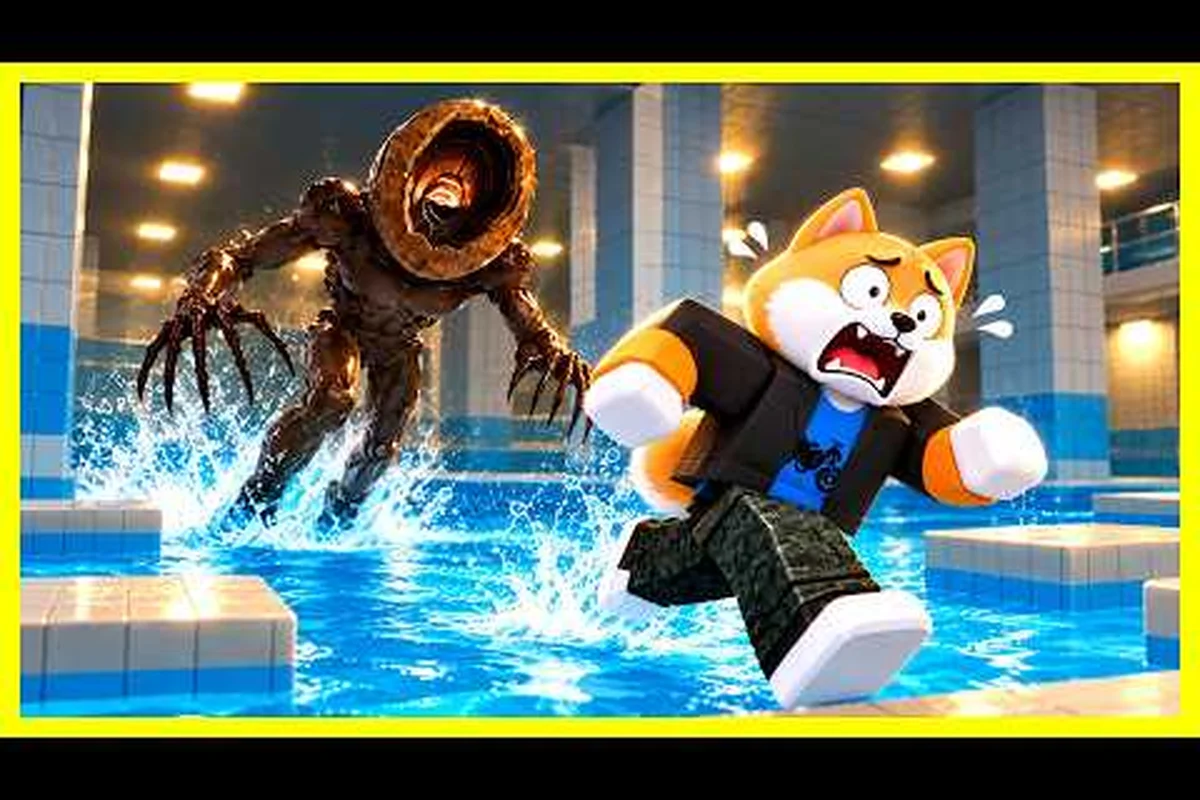
The dont splash monster chase becomes easier to survive once you understand that IT is blind and tracks splashing water. Listen for subtle movement cues, avoid water contact, and use pebbles to redirect its pursuit. Headphones can amplify the audio cues, while a pebble thrown across a nearby path gives the monster a false position to investigate. The key is to stop moving through wet areas as soon as IT approaches, because any splash can trigger its pursuit and force you into a frantic escape.
Dont Splash Monster Chase: What Starts a Hunt
IT does not need line of sight to hunt you in DONT SPLASH. According to the official DONT SPLASH game page, the creature navigates through splash detection: entering water, touching it during a jump, or knocking an object into it can all draw IT toward the disturbance.
That rule makes the dont splash monster chase less about finding a hiding place and more about controlling sound. Standing behind a wall will not help if water splashes nearby, while remaining on dry ground allows IT to patrol without a reliable target. The key distinction is simple: IT hears water, not movement.
| Event | Does it alert IT? | Result |
|---|---|---|
| Running on a dry platform | No | IT can remain unaware |
| Landing in a water pool | Yes | IT investigates the splash area |
| Touching water during a jump | Yes | IT may intercept you midair |
| Throwing a pebble into water | Yes | IT is lured toward the impact |
| Hiding behind scenery after a splash | No immediate benefit | The earlier splash can still draw IT over |
Understanding this behavior is only the first step. You also need to interpret the sounds that indicate IT has already committed to a chase. In DONT SPLASH, audio cues can help separate a random ambient noise from a monster response: a sudden splash followed by movement or a directional sound may suggest that splash detection has drawn IT toward your position. Headphones can make those cues easier to localize, but they do not replace sound control. If a jump lands in water or a pebble creates an impact, treat that alert as the beginning of a potential interception window and move away from the splash area before IT closes the distance.
The Three Stages of an Alert
A useful mental model divides the pursuit into three stages. First comes recognition, when a splash occurs and IT acquires a likely target. Next is movement, when IT travels toward that location. Finally, the charge begins if IT reaches or crosses your path.
Community gameplay reports suggest that experienced players judge distance by the changing audio character of IT’s approach. A low, underwater presence may signal routine patrol movement, while a sharper or faster cue can indicate pursuit. The exact sounds may vary with headphones, speakers, and game volume, so the reliable rule is to compare what you hear while IT is calm with what you hear after a disturbance.
This makes dont splash audio cues practical rather than decorative. Listen for a sound that differs from the baseline, stop moving toward the water, and prepare to use a pebble or a longer route. The monster behavior overview explains more about why IT cannot see avatars.
What Not to Confuse With a Chase
Many apparent pursuits are simple repositioning. If IT moves after a pebble impact, it has not necessarily found your position; it may only be following the lure. Likewise, a creature passing beneath a dry bridge is not proof of targeted pursuit. Its destination is easier to understand when you identify the most recent splash source.
| Observation | Most likely explanation | Best response |
|---|---|---|
| IT moves immediately after a pebble splash | Lure worked | Continue along the intended route |
| IT crosses the platform you just used | Possible pursuit | Change direction before it closes the gap |
| IT remains beneath the same pool | No fresh target | Wait or prepare a distant decoy |
| IT returns to a previously disturbed area | Delayed response | Stay silent and avoid nearby water |
Dont Splash Audio Cues: Reading IT’s Approach
Headphones provide a clear advantage because directional and timing information becomes easier to separate from platform sounds. The headphones advantage is not that they reveal IT visually; it is that they make subtle changes in pitch, volume, and movement easier to notice before a visible encounter becomes a dont splash monster jumpscare.
Use headphones at a moderate volume. If the audio is so loud that you cannot judge your own footfalls or distant splashes, you may also miss the contrast between ordinary ambience and IT’s movement. Community tips repeatedly recommend headphones, but the practical goal is accurate contrast, not maximum volume.
Build a Baseline Before Taking Risks
Before entering a risky route, stop on a safe platform and listen for several seconds. You are identifying the ordinary sounds of the level: water, ambient effects, distant splashes, and the movement of the surrounding environment. This baseline makes an unnatural sound easier to recognize.
The don’t splash listen for the monster approach is not a single sound to memorize; it is a change in the level’s audio pattern that signals how close the monster is and where it may be moving. Compare each pause with the baseline you just established: a faint ripple can be ordinary pool ambience, while a splash that cuts off abruptly, repeats at the same spot, or arrives with a directional scrape suggests that IT is entering the area. This is why the monster chase relies on careful listening rather than reacting to every noise: mistaking background water for a genuine approach can trigger a panic, while ignoring a subtle pattern change can leave you exposed on the route ahead.
-
A new continuous movement that was absent before.
-
A rapid increase in sound intensity.
-
A brief splash followed by an immediate change in nearby movement.
-
A sharp directional cue that suggests IT is crossing under your route.
-
A sudden close sound after the environment has been quiet.
Because the game is built around hearing rather than sight, treating audio as a live radar changes how you move. Pause often, especially near pools. A two-second pause can prevent a rushed jump that becomes the next chase trigger.
Comparing Useful Listening Methods
| Listening method | Strength | Limitation |
|---|---|---|
| Stereo headphones | Clear direction and distance contrast | Direction may be less precise in busy scenes |
| Single-ear headphones | Easier to hear game audio while hearing surroundings | Weakens directional separation |
| Large speakers | Good for shared play and ambient scale | Localized cues are harder to judge |
| Low game volume with headphones | Excellent subtle-sound contrast | Requires a quieter environment |
The best setup is not universal. Headphones help solo players distinguish a nearby approach, while speakers can make the creature’s movement obvious to a group. In either case, lower unrelated noise outside the game so the audio cues are easier to interpret.
Sounds That Should Trigger an Immediate Stop
The dont splash what alerts the monster question has a simple answer: water contact creates the target. However, you still need to react to the warning before the contact. Stop immediately if you hear a fast approach, see the water surface disturbed in a pattern that is not yours, or notice IT moving toward a pool you may soon need.
A common mistake is waiting for visual contact. If you are already moving when IT reaches the destination, your next jump may cross its path. Instead, pause before the hazard, identify the sound’s source, and choose one of three responses: retreat, wait for IT to pass, or throw a pebble farther away.
Dont Splash Splash Detection: Avoiding Every Trigger
Splash detection makes careful route planning more valuable than raw speed. Walking quickly across dry ground is usually safer than hesitating beside water, because a delayed jump often turns into a panicked leap. Before every route, identify all water edges, narrow platforms, and objects that could roll or fall into a pool.
The guide to what counts as a splash examines falling into water and touching it during a jump. The practical takeaway is to treat the entire surface of a pool as dangerous, even a small visible edge. A character can begin a jump on dry ground and still clip the water at the end.
Pre-Plan the Landing Zone
Before committing to a jump, scan the route as a connected three-point sequence: the takeoff surface, the highest point of the midair path, and the first solid landing area. Check each point separately for water, unstable edges, and blocked footing; for example, a dry takeoff does not make a jump safe if the midair path clips the pool’s edge or the landing zone ends at a drop. This three-point check prevents a splash detection event from triggering the dont splash monster chase and helps you choose a safer route before the monster commits to the lure.
-
Takeoff point: Confirm it is dry and stable.
-
Midair path: Keep enough height to clear the water’s edge.
-
Landing point: Ensure the landing remains entirely on solid ground.
| Jump type | Risk | Safer alternative |
|---|---|---|
| Short gap over a narrow pool | Medium | Add a dry platform route |
| Wide jump requiring a long drop | High | Find a lower, longer path |
| Jump beside a vertical water wall | High | Move farther from the edge first |
| Jump onto a small dry ledge | Medium | Land slowly and check the footing |
| Jump away after a nearby lure | High | Wait until IT commits to the lure |
Speed helps only after the route is safe. A perfectly timed sprint into a water-filled corridor creates the very splash that starts the dont splash monster chase. Slow down at every boundary and accelerate only on a verified dry stretch.
Keep Objects Away From Water
A pebble is useful because it deliberately creates a controlled splash, but random objects can be dangerous. Players have reported that thrown or displaced items touching water can also alert IT, so do not assume every impact is harmless. This distinction matters because IT’s splash detection may respond to the disturbance itself rather than the object’s origin: a bottle that misses the pool and hits a ledge can still make a sharp impact, while a loose plank sliding into the water can produce a louder, more irregular splash. Listen for the monster and use audio cues to judge whether the object entered the intended pool cleanly; if you hear a ricochet or a second impact, pause and reassess before moving through its path.
Use a pebble only when you can confirm the landing point. An uncertain throw may miss the pool, strike a platform, or create a second disturbance in an unintended direction. The safest decoy lands cleanly in a pool far from the path you need to take.
Use Pebbles as a Route-Drawing Tool
A pebble is most valuable when it changes IT’s position before you cross a dangerous zone. Throw it toward the opposite side of the map, wait for IT to commit, and then take the route that was previously blocked. This works best when the lure creates one clear splash rather than several uncertain noises.
| Lure situation | Expected benefit | Caution |
|---|---|---|
| Pool opposite your route | Opens a safer crossing | Do not throw before reaching cover |
| IT already approaching you | Draws it away | Use enough distance to avoid interception |
| Narrow dry bridge | Sends pursuit to a safer area | Pebble must land in water |
| Very short distance | Limited separation | Find a farther pool if possible |
The official game page identifies pebble-like distractions as a means of manipulating sound-based pursuit, while community footage shows IT moving toward a deliberate pebble splash. Treat the sound cue as a controllable lure: land one isolated splash across a narrow dry bridge, then confirm that IT has committed to that direction before crossing. A single, sharp splash is easier to track than overlapping audio cues, which can obscure its approach and leave you unsure whether the distraction succeeded.
Dont Splash Headphones Advantage: A Practical Play Plan
A good sound-based play plan combines headphones with deliberate movement, environmental awareness, and decoy timing. The goal is not to hear IT earlier than the game intends, but to notice the transition from patrol to pursuit before your route creates a new splash.
Community experience suggests a simple three-part routine: listen, pause, commit. Listen for environmental changes, pause long enough to establish whether a sound is approaching, and commit only when you know both your landing point and IT’s likely direction.
The Three-Stage Escape Loop
When you realize IT is coming, use this sequence: pause before reacting so you can separate the monster’s approach from a false alarm, then listen for the audio cues that reveal whether IT has noticed your recent pebble splash. If IT is still investigating the original splash, redirect it before committing to a route; if it is already tracking you, prioritize getting to stable ground rather than throwing another pebble. This distinction matters because every splash creates a new noise event, and an unnecessary lure can turn one monster approach into two competing distractions.
-
Freeze: Stop at the edge of your route so your character does not slide or jump into water.
-
Locate: Determine whether IT is heading toward you or toward a recent pebble splash.
-
Redirect: If needed, throw another pebble to a distant pool on the opposite side.
-
Move: Cross only after the creature has committed away from your path.
-
Settle: Reach stable dry ground and listen until IT’s movement loses urgency.
The dont splash monster chase becomes much less chaotic when you replace panic movement with this loop. Each stage answers a different question: whether danger is near, where it is going, whether you need a lure, and when movement is safe.
When to Use Sound Instead of Sight
You should rely on sound when IT is still out of view, when water blocks your line of sight, or when the creature moves under a platform. In these situations, waiting for a visual cue is too late. Use audio to begin moving away from the likely destination.
| Situation | Primary information source | Action |
|---|---|---|
| IT is below a platform | Audio direction | Move laterally from the pool |
| Water hides IT’s body | Audio intensity | Pause and hold a safe route |
| IT crossed a dry bridge | Visible movement plus sound | Continue to dry cover |
| Only a faint cue is present | Ambiguous audio | Wait briefly to verify |
| A fresh splash occurred | Known source | Track IT away from that source |
This process also clarifies what alerts the monster: IT reacts to the splash, but your escape can begin with the sounds preceding its arrival. A wet footstep, dripping water, or movement through the pool can signal IT before the splash itself marks your position, so headphones make those audio cues easier to separate from ambient noise. For example, if you hear water shifting behind a platform, move sideways from the pool before a fresh splash gives away your location; the audio cue starts the retreat, while the splash confirms the source.
Group Play Versus Solo Play
In groups, one player can watch the water while another listens for IT. That division of attention makes pebble throws safer because one person can verify the lure and the creature’s movement. The player who sees IT should call directions immediately rather than saying only “run.”
Solo play requires more conservative timing. Do not throw a pebble while crossing a narrow platform because the distraction may move IT toward your route. Pause, listen, and wait for a clear positional advantage. The creature distraction guide provides more detail on using patrol movement against IT.
Surviving the Dont Splash Monster Jumpscare
A dont splash monster jumpscare usually follows a failed escape: IT reaches your position, intercepts a jump, or continues toward the last known splash until it finds you. The solution is prevention rather than reaction speed. Reduce the number of splashes, make every decoy intentional, and avoid spending time near water after attracting attention.
When the creature gets close, a direct retreat across the same pool may create a second target. Move sideways along a dry route instead. If you have no dry exit, use a pebble to redirect IT before it reaches you. Only attempt a jump after confirming that your path does not intersect the creature’s position.
Diagnose the Last Mistake
After a failed run, review the final 10 seconds rather than blaming random chance. Focus on the last movement, camera direction, and audio cue, because the monster’s chase is driven by a short chain of player actions: a splash can trigger an alert, an alert can prompt an approach, and your response then determines whether the encounter ends safely. For example, if you heard a new footstep or water sound but kept sprinting through a pool, the failure was caused by continuing after the alert, not by the monster guessing your position. A replay or frame-by-frame check of that window helps separate an unavoidable jump scare from a preventable detection chain.
-
You entered a pool instead of taking a dry route.
-
You jumped without confirming the landing surface.
-
You threw a pebble too close to yourself.
-
You kept moving after hearing a new approach.
-
You paused near the water where your last splash occurred.
-
You assumed hiding would erase the alert.
The official description confirms that IT is blind, so searching for a hiding place after a splash is usually wasted time. Sound can reveal your position, but visual contact does not: IT still chases the last noise it detected, so stopping behind cover without changing your noise pattern may only preserve the alert. A precise explanation of that behavior appears in the water-sensitive monster analysis; for example, a player who splashes in a pool and then stands still nearby can still be caught when the monster follows the water sound into that area.
Last-Minute Recovery Rules
| Situation | Immediate action | Avoid |
|---|---|---|
| IT is approaching a pool you occupy | Move to dry ground | Jumping across the pool |
| Your jump clips water | Use a pebble as soon as possible | Continuing to the original route |
| A lure landed nearby | Freeze and re-evaluate | Assuming IT moved away |
| You hear a close approach | Stop moving | Sprinting blindly |
| The only path crosses water | Check the jump arc | Assuming a long jump is safe |
The dont splash monster jumpscare is easiest to prevent when you accept that IT already knows where the last splash occurred. It does not need to see you, so hiding behind a wall does not erase the alert. Create a newer, better-controlled target with a pebble, then use the dry route while IT moves away.
Frequently Asked Questions
What actually alerts IT in DONT SPLASH?
IT is attracted primarily to splashing water, not to ordinary running or sight. Falling into a pool, touching water during a jump, or knocking an object into water can create an alert. Because IT is blind, it moves toward the detected splash rather than directly tracking your body. The official game page confirms this core behavior.
Do headphones really improve survival in DONT SPLASH?
Yes, when they help you distinguish subtle movement from ordinary ambient noise. Headphones do not change the rules, but they can make the direction and intensity of IT’s approach easier to recognize before contact. Keep the volume moderate enough to hear nearby splashes and compare the creature’s sounds with the level’s normal background noise.
Can you stop IT after it notices a splash?
You cannot kill it, and hiding alone does not reliably remove the alert. The practical method is to create a controlled distraction by throwing a pebble into distant water, then move along a dry route while IT travels toward the decoy. The decoy must land clearly in water and be far enough away to pull the creature off your path.
Should you run immediately when IT starts moving?
Not always. A blind sprint can lead to a jump that clips water or crosses IT’s route. Stop near a dry safe point, identify whether IT is approaching you or a prior splash, and use a distant pebble when needed. This listen-and-redirect approach is usually safer than reacting to every sound with uncontrolled movement.
Can a jumpscare be triggered without touching the water?
Yes, because a splash can happen before you personally touch the pool. A falling object, a thrown pebble, or another player’s mistake may alert IT and bring it into your route. The resulting dont splash monster chase can end in a jumpscare even when your avatar never entered the water directly, so watch shared hazards and avoid careless throws near escape paths.